In the first segment of the poem, we are introduced to Sir Gawain and the Green Knight. It is Christmas time in King Arthur`s court when the Green Knight enters the dining hall. He is very large and completely green. He challenges the court to a beheading game in which one of the knights must cut off the Green Knight`s head and then in 12 months and a day find the Green Knight and allow the Green Knight to chop his head off. When none of the knights of the Round Table take up his challenge, he taunts them and says, "What, is this Arthur`s house.../Whose fame so fair in far realms and wide?/Where is now your arrogance and awesome deeds./Your valor and your victories and your vaunting words?/.../Overwhelmed with a word of one man`s speech./For all cower and quake, and no cut felt!"(208-209). This angers Arthur and he gets up to take the challenge. This is the point where we see the first glimpse of Sir Gawain`s character. Sir Gawain asks Arthur to allow him to take the challenge. We see how Sir Gawain feels about himself when he gives his reasons for being allowed to take the challenge. Sir Gawain tells Arthur that he is "..the weakest, well I know, and wit feeblest;/And the loss of my life will be the least of any" (208).
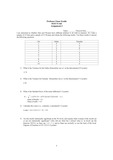
Professor Omar KeshkIS/ECO 443Assignment 3Name ________Choyeon Kim_________I am interested in whether Men and Women have different abilities to do well in statistics. So I take a sample of 10 Men and a sample of 10 Women and obtain the following results. Use these results to answer the following questionsObsMalesFemales19**************************046What is the Variance for the Males (Remember use n-1 in the denominator)?(5 points)5.79What is the Variance for Females (Remember use n-1 in the denominator)? (5 points)2.32What is the Standard Error of the mean difference? (5 points)S = ( (10*5.79 + 10*5.32)/18 )*(20/100) =1.1mean of female = 6.1Mean of male = 4.3Calculate the t-ratio (i.e., t-statistic, t-calculated)? (5 points)t-ratio = (6.1-4.3)/ (1.1 / 3) = 4.9Are the results statistically significant at the 5% level, and explain what it means if the results are or are not statistically significant? (Also tell me what the t critical value is: in Excel use the function TINV(), in Spss use IDF.T(), and in Stata use invttail() or use the back of the book. Degrees of Freedom is (N1+N2-2) (5 points).Table 4.2:ObsXY()()()()1-10-1-(-0.375)=-0.6250.3750.625*0.375=0.2340.3910.1412-1-2-0.625-1.6251.0160.3912.641300-0.3750.375-0.1410.1410.14140-1-0.3750.625-0.2340.1410.1415111.3751.3751.8911.8911.8916-1-10.6250.6250.3910.3910.3917000.3750.3750.1410.1410.1418-100.6250.3750.2340.3910.141Sums-3-3**3.5323.8785.628Means-3/8=-0.375-3/8=-0.375*****Fill in all the cells, except for those marked by an asterisk (5 points)Calculate Pearson’s r correlation coefficient? (7 points)r = 3.532/ (3.878*5.628) = 0.756What does the result you obtain say? (7 points)Pearson’s r indicates that x and y are fairly strongly correlated in the positive direction.Now calculate whether the result you obtained is significantWhat is the null hypothesis? (7 points)Mean of x is equal to mean of y.What is the calculated t statistic? (7 points)T(7) = -0.375 -Are the results significant at the 5% level and explain what it means if the results are or are not statistically significant? (Show me the appropriate t critical value also. Degrees of Freedom = N-2) (7 points)Table 4.3:ObsX(Age)Y(Height in Inches)()()()15464-6.7-2.315.4144.8925765-3.7-1.34.8113.6935866-2.7-0.30.817.29462691.32.73.511.6955748-3.7-18.367.7113.69667596.3-7.3-45.9939.6975978-1.711.7-19.892.89868757.38.763.5153.29965744.37.733.1118.49106065-0.7-1.30.910.49Sums607663**123.9196.1Means60.766.3****12) Fill in all cells except those with an asterisk in them (5 points).The research question is whether Height is contingent upon Age.13) Calculate the Slope? (5 points)y=a + bxslope b = 123.9 /196.1 = 0.614) Calculate the Intercept? (5 points)Intercept a = 66.3 – 0.6 * 60.7 = 29.8815) Write out the resulting regression equation and tell me what it is saying, write the equation that was estimated and interpret the slope and the constant in that equation. (20 points)y = 29.9 + 0.6xThe slope gives a value in “y-unit per x-unit.” It means when x increases by 1, y increases by 0.6.The intercept gives a starting value in y-unit. It’s the y^-value when x is 0.Y= 29.9 + 0.6 * 60 = 65.9PAGE PAGE 1
Define the following terms (3 point each):1)Sample: A small number of observations taken from a population.2)Population: the whole or all the observations on a specific characteristic of interest.3)Sampling without replacement: Removing an observation from a population and not returning to the population before taking out another observation.4)Sampling with replacement: Removing an observation from a population and returning to the population before taking out another observation.5)Random Sampling: every member of the population has an equal probability of being included or chosen. In other words when we choose a sample our selection criteria is chance.6)Standard Error: standard deviation of a sampling distribution.7)Probability Distribution: a function that assign a probability to every possible outcome of a random variable.
A Reflection on theTime on the CrossThe history of black slavery in the American soil which started in the 16th century and ending in the 19th century was a sight that no one in this present time would attempt to look back without a feeling of guilt and sympathy. The issue of slavery would be dragged in the present time where our civil virtue’s prime ingredients are morality and ethics. This present generation must have failed however to recognize this virtue to the end that slavery as an immoral act in the development of the United States constituting the enslavement of Africans remained to be an unresolved issue. Hence, it was the aim of the book under consideration to "strike down the view that black Americans were without culture, without achievement, and without development for their first two hundred and fifty years on American soil" (Fogel & Engerman, 1974). And this was compounded by (1) failure to acknowledge that the grandeur of the United States was based, in substantial pars. In fact this book was, over time, criticized as unscientific and impressionistic, and with egregious errors (David, et. al., 1976) by some scholars.If one will be asked whether or not slavery was doomed without the Civil War, the answer is in the positive. This answer need not even be based on any author’s idea but may hinge alone on morality and righteousness. This is in addition to the concept of equality, liberty and freedom of every individual person regardless of race which are enshrined in the constitution of every state as well as the United Nations Charter. Slavery is doomed because it is characterized by inherent wrongness, as it is characterized by oppression, crime, violence and abuse contrary to human dignity and pride (Lane, 1976). As the whole world would condemn and abhor it and as it is inherently wrong regardless of any standard by creed, culture and tradition, slavery would have to meet a natural death.We could observe that there were very few slave uprisings. The ht and power of their oppressors which were armed and equipped with resources.Using economics in order to gauge how well the slaves compared to other groups would not be accurate and feasible. When using economics’ principles and methods as opposed to the lack of their application in especially in this book by Fogel and Engerman would not reveal an accurate truth of the plight of slavery compared with other groups. As slavery is peculiar to any human situation, it would not be even fair to take economic measure in deducing their situation. Slavery, to an extent can be considered human rights violation consisting of deprivation of economic and political rights. This situation is not ordinary economic issue that can be quantified or measured by economic parameters.The quality of life for slaves was not only oppressive but degrading and dehumanizing. If it is unimaginable to think when the present household helpers are not treated well by their employers, then it is with more reason to obhe growth of the American economy. Regardless of the contention that this work of Fogel and Engerman lacked scientific explanation as regards their claim. However, even without any economic parameters to assess this claim would not denigrate on the truth of the slavery’s huge contribution to the economy. This contribution of slavery cannot be dispensed with when speaking of their necessity in the economy when profits in the plantations they worked in would be used to purchase more slaves (Dodson, 2003).With regard to the query on why did slavery persist, the answer can be derived from the first question on why there were very few uprisings among the slaves. The prolongation of their status in the American society was based on the fact that they have no strength and power to overcome the force of the American rich population. The lack of education from their forefathers to the next generation would also contribute to this because of lack of awareness that is comprehensive to trigger a cce that it tells us is the undesirability of the past that humanity must be able to work out towards a goal that every human being is free from abuse, discrimination and violence. Without the struggle against this oppressive event in the history, the present generation would not be better today. Absence of the fight for freedom in favor of the black Americans would not reveal their talents and sterling contributions to various sectors of the society.Despite the alleged inaccuracies and errors in this book, it could tell us that there are truths to a claim with even without the support of any scientific or mathematical basis. After all, truth is what we feel inside our hearts and conscience that logic and rationalization of things is not capable of doing.REFERENCES:Walters, R. (2000) Reparations for Slavery? Let’s resolve the inequity. World and I. Vol. 15.David, P., et al. (1976). Reckoning With Slavery: Critical Essays in the Quantitative History of American Negro Slavery. New York: O
Youth and Lethal ViolenceThis paper seeks to highlight Garbarino’s points and strategies in approaching issues pertaining to youth and lethal violence. His main points and arguments will be discussed. The proposals for addressing violence in adolescent males will be highlighted. The question on how the society is falling short in meeting the developmental needs of male adolescents will be answered. At the end of this, personal conclusion will be reached.The 1997-1998 murders on campuses committed by youthful offenders were the very foundation of James Garbarino’s book Lost Boys: Why Our Sons Turn Violent and How We Can Save Them. The book would reveal that the ill-fated violence on campuses committed by youthful males as an epidemic and not a simple incident of a crime. Garbarino has shown insights unrevealed by our ignorance on youth violence. The author has inquired thoroughly neither on the stem nor the branches but the roots by investigating the young minds behind these juvenile dees are rather complex which may not be solved by simple mathematical formula. Hence, he made an extensive research on youthful offenders like Shareef Cousin, Malcolm, Kip, Luke, Andrew and many others whose revelations were disturbing and raises more issues than what were ordinarily perceived by the society.The author also advocated that the problem should be inquired into beyond the short term trends but must consider the long term and historical trends of this phenomenon in the society. Taking into consideration were the FBI’s statistics on “juvenile arrests for possession of weapons, aggravated assault, robbery, and murder rose more than 50 percent from 1987 to 1996” (Garbarino, 1999). This is not to mention the serious assaults committed by juvenile delinquents after World War II. He could also not ignore revelations of statistical highlights that people in the society “no longer can any of us believe that we and our children are immune to lethal youth violence, because today almosiolence. Factors like child abuse, gangs, substance abuse, weapons, arrests and neurological problems were taken up but ruled out that they are not exclusively determinants.Noticeably, in his related journal, Garbarino (1999) would declare the complexity and seriousness of youth and lethal violence when he said that, “Understanding the effects of violence on children demands an interdisciplinary perspective, one that incorporates psychological, biological, sociological, anthropological, and historical insights. Each year in the United States nearly 5,000 children and youth commit acts of lethal violence, half against others-murder--and half against themselves--suicide. The number of children and youth who commit potentially lethal acts is, of course, many times greater if we include the tens of thousands of serious assaults and suicide attempts that take place each year involving minors. For each of these kids, and for the families, communities, and societies of which they are a part, that they will commit acts of lethal violence.Education for parents (starting before children are born) and teachers is crucial to giving them the special skills and motivation necessary to create home and classroom environments that prevent violence.Child abuse prevention is the cornerstone of preventing lethal youth violence. The most common pathway to this pattern of aggression at age 8 is for temperamentally vulnerable children to be the victims of abuse and neglect at home. As a result, these children develop a negative pattern of relating to the world in general. This abusive maltreatment can be both physical and psychological.Detoxifying the social environment of children and youth is essential to protecting them from the problem of lethal violence. Lost, troubled boys will be as bad as the social environment around them. I have identified this as the issue of "social toxicity," the presence of social and cultural poisons in the world of children and youth, to which lost boys aionGarbarino’s approach to the issue at hand not only offered us many new insights on how it may be responded to. It helped us to understand that the problem of youth and violence has its own roots and must be treated according to various circumstances which our society has failed to realize. It tells us that a violent young does not commit violence for the sake committing it but has reasons behind and not even apparent to our naked eyes. Garbarino’s observation on how society has treated the problem on the basis only of legal parameters runs contrary to the compassionate and understanding of a civilized world which is expected to breed useful and good citizens of tomorrow.Thus, in treating the problem, the society as a whole must work together to solve the problem than rely alone on incarceration of these young offenders. It takes a school, community, household and government agencies working together to save the lost boys who may have dreamed a better life yet disappointed by carefreim